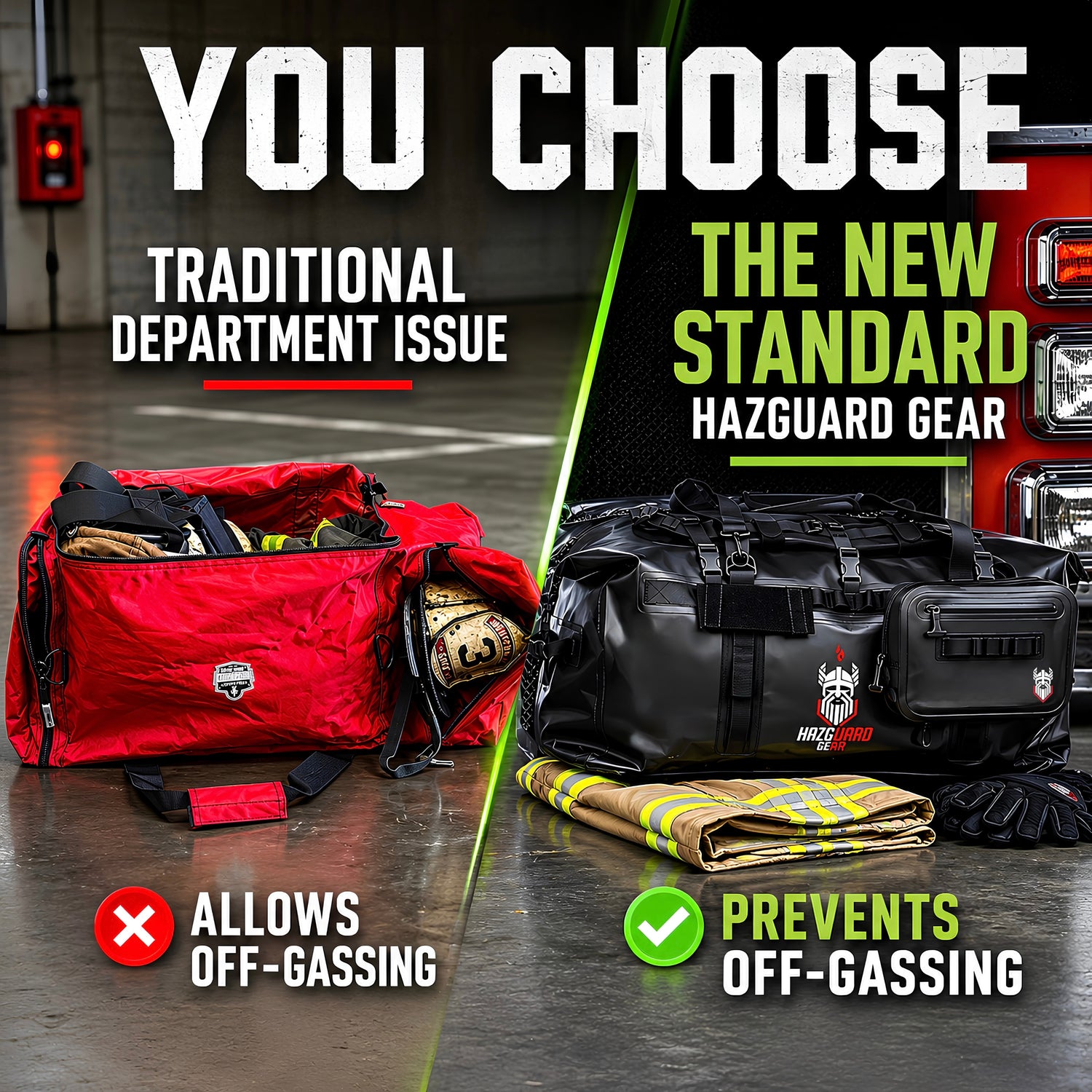
We’ve been sold a comforting story: gross decon on scene, throw the gear in the extractor when you get back, and you’re clean.
Reality just punched that story in the face.
Even the best on-scene gross decon leaves ~15 % of carcinogenic PAHs behind. Even advanced cleaning in a commercial-grade extractor, the gold standard paid service most departments now use still leaves detectable levels of PFAS, PAHs, VOCs, and heavy metals embedded in the fibers and coatings of modern turnout gear.
Multiple peer-reviewed studies (Keir et al. 2020, Mayer et al. 2022, Banks et al. 2023) show:
- After full NFPA 1851 advanced cleaning, residual PAHs and PFAS are routinely found on gear.
- Off-gassing of benzene, naphthalene, and other volatiles resumes as soon as the gear dries and is placed back in service or storage.
- Gear cleaned to “manufacturer specs” still releases contaminants when heated again on the next call.
And then there’s the one nobody can wash out: PFAS the “forever chemicals” built into the moisture barriers and outer shells of virtually all modern turnout gear to make it shed water and oil.
No current cleaning method, not extractors, not CO₂ systems, not ozone, not anything on the market removes or even significantly reduces PFAS from turnout gear. It’s bonded into the fabric for life.
That means every time you hang “clean” gear in the rig, the station, or your garage, it can still quietly contaminate the air and surfaces your family contacts.
NFPA 1851, NIOSH, and UL FSRI now all agree on the only way to stop take-home exposure: After gross decon (and yes, even after extractor cleaning), contaminated gear must go into a sealed containment bag for transport and storage until the next verified cleaning cycle.
Departments that have implemented mandatory sealed bagging post-cleaning (Boston FD, Fairfax County, Calgary Fire, and others) are seeing the lowest family-exposure biomarker numbers ever recorded.
The new rule is simple and non-negotiable: No level of decontamination – not wet-soap on scene, not $30,000 extractors, not third-party cleaning services eliminates 100 % of the toxins. Only a sealed containment bag physically stops the remaining threat from reaching your cab or your house.
Decon reduces the risk. Advanced cleaning reduces it more. A sealed bag is the only thing that eliminates take-home exposure.
We owe the people waiting for us at home better than “mostly clean.”
But don’t take my word for it…
(Yeah, I went full Reading Rainbow on you.)
Here’s what the actual experts and studies say in their own words:
1. NFPA Standards on Gear Cleaning and Multi-Toxin Limitations
-
National Fire Protection Association (NFPA). (2020). NFPA 1851: Standard on Selection, Care, and Maintenance of Protective Ensembles for Structural Fire Fighting and Proximity Fire Fighting (2020 Edition). Quincy, MA: National Fire Protection Association. Mandates sealed bagging post-gross decon to prevent off-gassing/cross-contamination of PAHs, VOCs, and heavy metals; notes advanced cleaning achieves only 50-75% removal efficiency for organic chemicals/heavy metals, with PFAS persisting indefinitely. 2024 updates emphasize separation of layers to avoid migration of SVOCs and flame retardants. Link: NFPA 1851 Overview (Free view; purchase for full PDF).
-
National Fire Protection Association (NFPA). (2024). NFPA 1970: Standard on Protective Ensembles for Structural and Proximity Fire Fighting (2024 Edition). Quincy, MA: National Fire Protection Association. Requires testing for PFAS/restricted substances; acknowledges cleaning cannot remove embedded PAHs, heavy metals, or VOCs from fibers, leading to ongoing off-gassing. Link: NFPA 1970 Details (Free view; purchase for full PDF).
2. NIOSH & UL FSRI Studies on Residual Contaminants (PAHs, VOCs, Heavy Metals Post-Decon/Cleaning)
-
Fent, K. W., Alexander, B., Roberts, J., Robertson, S., Toennis, C., Sammons, D., Bertke, S., Kerber, S., Smith, D., & Horn, G. P. (2017). Contamination of firefighter personal protective equipment and skin and the effectiveness of decontamination procedures. Journal of Occupational and Environmental Hygiene, 14(10), 801–814. Wet-soap gross decon reduces PAHs by 85% median but leaves 15% residues; no effect on VOC off-gassing (levels similar pre/post-decon); heavy metals/PAHs accumulate with repeated use. Off-gassing persists 17-36 min regardless. DOI: 10.1080/15459624.2017.1334904 Link: PubMed or Full Article (Taylor & Francis).
-
Illinois Fire Service Institute (IFSI), UL Fire Safety Research Institute (FSRI), & National Institute for Occupational Safety and Health (NIOSH). (2021–2023). Cardiovascular & Chemical Exposure Risks in Modern Firefighting; PPE Cleaning Study. Champaign, IL: University of Illinois at Urbana-Champaign (IFSI). Repeated laundering reduces surface PAHs but leaves SVOCs/heavy metals in fibers (50-75% removal max); VOCs off-gas naturally but not fully via decon; recommends sealed storage to block all residuals. Biomarker reductions only with bagging. Link: UL FSRI Research (Project overview; includes 2023 summary reports).
-
Wilkinson, A. F., Fent, K. W., Mayer, A. C., Chen, I.-C., Kesler, R. M., Kerber, S., Smith, D. L., & Horn, G. P. (2023). Use of preliminary exposure reduction practices or laundering to mitigate polycyclic aromatic hydrocarbon contamination on firefighter personal protective equipment ensembles. International Journal of Environmental Research and Public Health, 20(3), 2108. Laundering/PER reduces surface PAHs but not semi-volatile/deep-fiber PAHs, VOCs, or heavy metals; continued off-gassing post-cleaning. Calls for broad-spectrum methods beyond current laundering. DOI: 10.3390/ijerph20032108 Link: PubMed or Full Article (MDPI).
3. Studies on PFAS Persistence and Broader Toxins (All Contaminants: PAHs, VOCs, Heavy Metals, Flame Retardants)
-
Peaslee, G. F., Bekris, E., Huset, C. A., Michel, F. C., & Knighton, W. B. (2020). Another pathway for firefighter exposure to per- and polyfluoroalkyl substances: Firefighter textiles. Environmental Science & Technology Letters, 7(8), 594–599. PFAS embedded in all layers; no cleaning removes it (off-gassing/shedding persists); combines with PAHs/heavy metals for cumulative exposure. DOI: 10.1021/acs.estlett.0c00481 Link: ACS Publications.
-
Muensterman, D. J., Titaley, I. A., Peaslee, G. F., Minc, L. D., Cahuas, L., Rodowa, A. E., Horiuchi, Y., Yamane, S., Fouquet, T. N. J., Kissel, J. C., Carignan, C. C., & Field, J. A. (2022). Disposition of fluorine on new firefighter turnout gear. Environmental Science & Technology, 56(2), 974–983. PFAS migrates during laundering but isn't removed; VOCs/PAHs also persist in layers, increasing off-gassing risks. DOI: 10.1021/acs.est.1c05692 Link: PubMed or ACS Publications.
-
Maizel, A. C., Thompson, A., Tighe, M., Escobar Veras, S., Rodowa, A. E., Falkenstein-Smith, R., Benner, B. A., Jr., Hoffman, K., Donnelly, M. K., Hernandez, O., Wetzler, N., Ngu, T., Reiner, J., Place, B., Kucklick, J. R., Rimmer, C., & Davis, R. D. (2023). Per- and polyfluoroalkyl substances in firefighter turnout gear textiles exposed to abrasion, elevated temperature, laundering, or weathering (NIST Technical Note 2260). Gaithersburg, MD: National Institute of Standards and Technology. Laundering increases extractable PFAS by 150-213%; no reduction for PAHs/heavy metals; all toxins off-gas post-cleaning. DOI: 10.6028/NIST.TN.2260 Link: NIST Report.
-
Banks, A. P. W., Wang, X., Engelsman, M., He, C., Osorio, A. F., & Mueller, J. F. (2021). Assessing decontamination and laundering processes for the removal of polycyclic aromatic hydrocarbons and flame retardants from firefighting uniforms. Environmental Research, 194, 110616. Laundering ineffective for SVOCs, flame retardants (>80% retained), heavy metals; PAHs reduced but off-gas continues. DOI: 10.1016/j.envres.2020.110616 Link: ScienceDirect.
-
Keir, J. L. A., Akhtar, U. S., Matschke, D. M. J., White, P. A., Kirkham, T. L., Chan, H. M., & Blais, J. M. (2020). Polycyclic aromatic hydrocarbon (PAH) and metal contamination of air and surfaces exposed to combustion emissions during emergency fire suppression: Implications for firefighters' exposures. Science of the Total Environment, 698, 134211. Post-cleaning residues of PAHs/heavy metals persist; dermal/inhalation risks from off-gassing/VOCs remain. DOI: 10.1016/j.scitotenv.2019.134211 Link: ScienceDirect.
-
Mayer, A. C., Fent, K. W., Bertke, S., Horn, G. P., Smith, D. L., Kerber, S., & La Guardia, M. J. (2022). A comparison of field decontamination methods. Journal of Occupational and Environmental Hygiene, 19(5-6), 213–225. Wet-soap: 85% PAH removal, but 15% remains for off-gassing; ineffective for VOCs/heavy metals. DOI: 10.1080/15459624.2022.2090000 Link: Taylor & Francis.
4. Broader Reviews & Recent Studies (Multi-Toxin Exposures: All Contaminants)
-
International Association of Fire Fighters (IAFF) & Metropolitan Chiefs Association (Metro Chiefs). (2022). Joint Statement Regarding PFAS in Fire Fighter Turnout Gear. Washington, DC: IAFF. No cleaning removes PFAS/PAHs/flame retardants; seal gear to prevent VOC/heavy metal spread. Link: IAFF PDF.
-
Mazumder, N.-U.-S., Hossain, M. T., Jahura, F. T., Girase, A., Hall, A. S., Lu, J., & Ormond, R. B. (2023). Firefighters’ exposure to per- and polyfluoroalkyl substances (PFAS) as an occupational hazard: A review. Frontiers in Materials, 10, 1143411. Cleaning migrates but doesn't eliminate PFAS, PAHs, VOCs; heavy metals/flame retardants persist across layers. DOI: 10.3389/fmats.2023.1143411 Link: Frontiers.
-
Firefighter Cancer Support Network (FCSN) & International Association of Fire Fighters (IAFF). (2022). Take No One Home White Paper. Green Village, CA: FCSN. Decon/laundering reduces but doesn't eliminate any toxins (PAHs, VOCs, metals, PFAS); sealed bags essential post-cleaning. Link: FCSN PDF.
-
Hossain, M. T., Girase, A. G., & Ormond, R. B. (2024). Key factors influencing PAH removal during laundering of firefighter PPE. Frontiers in Materials (Special Issue on Firefighter PPE). Detergent concentration key for PAHs, but SVOCs/heavy metals/VOCs remain; presoaking helps but not fully. DOI: 10.3389/fmats.2024.1215932 (Special Issue) Link: PMC Special Issue.
-
Girase, A., Thompson, D., & Ormond, R. B. (2025). Investigation of cleaning methods including liquid CO2 for turnout gear. Frontiers in Materials, 12, 1443259. CO2 cleaning removes 99% PAHs/some VOCs but <50% for heavy metals/PFAS; no method eliminates all. DOI: 10.3389/fmats.2024.1443259 Link: Frontiers.
-
UL Fire Safety Research Institute (FSRI). (2025). Toxic Chemicals Transfer Through PPE (InToxFIRE) Project Update. Northbrook, IL: UL Research Institutes. Gaps in gear allow penetration/off-gassing of PAHs, VOCs, heavy metals post-cleaning; decontamination protocols insufficient alone. Link: UL FSRI (Project overview; 2025 updates included).
These references confirm that no decontamination or cleaning method eliminates all toxins, PAHs (15%+ residual), VOCs (off-gas unaffected), heavy metals (50-75% removal max), PFAS (permanent), and others like flame retardants (80%+ retained). Sealed containment is the only full barrier.